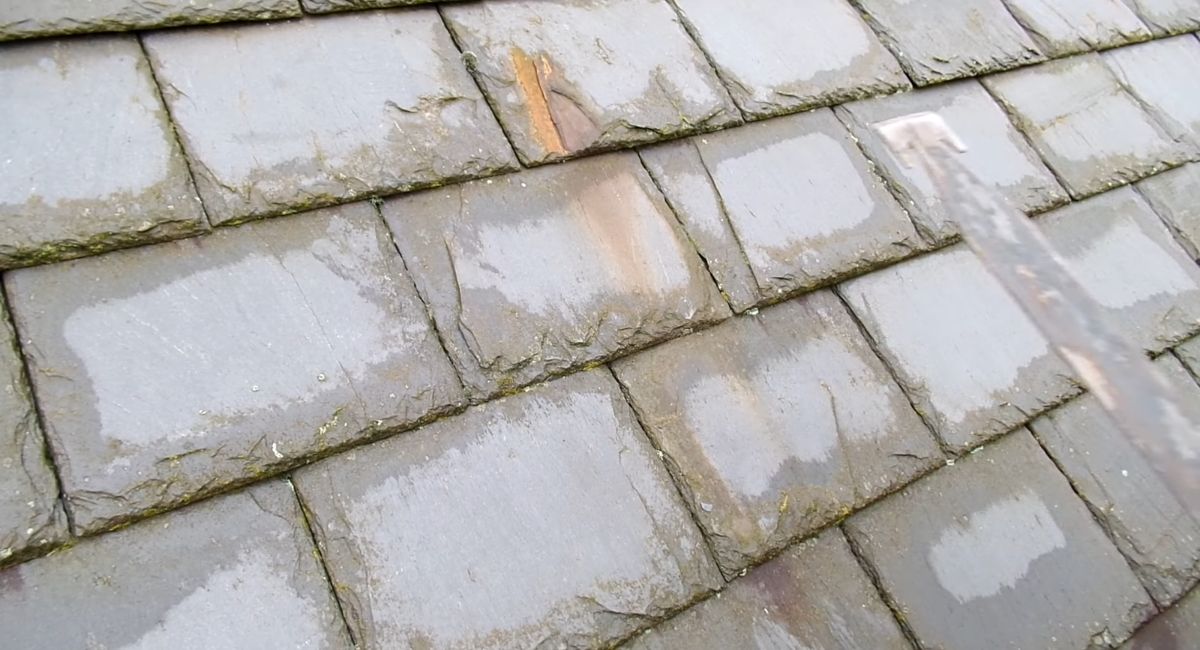
A single cracked slate looks like the easiest repair on the house. Pull the broken piece, slide in a new one and nail it where the old one was nailed.
Then you look closer and see that the old nails sit under the slates above, where no hammer can reach.
Most people stall right there, and I understand why.
Every roof built from overlapping pieces hides its fasteners on purpose, and I have worked on enough tile to know how stubborn that design feels when one piece fails.
Slate adds weight and brittleness. Roofers solved the hidden nail problem long ago, without tearing off the course above.
Cut the Hidden Nails, Then Fasten the New Slate Through the Joint Above
You replace one broken slate by cutting its hidden nails with a slate ripper, sliding in a matching slate, nailing it through the joint in the row above and covering that nail with a small copper bib.
The Five Steps of a Single-Slate Replacement
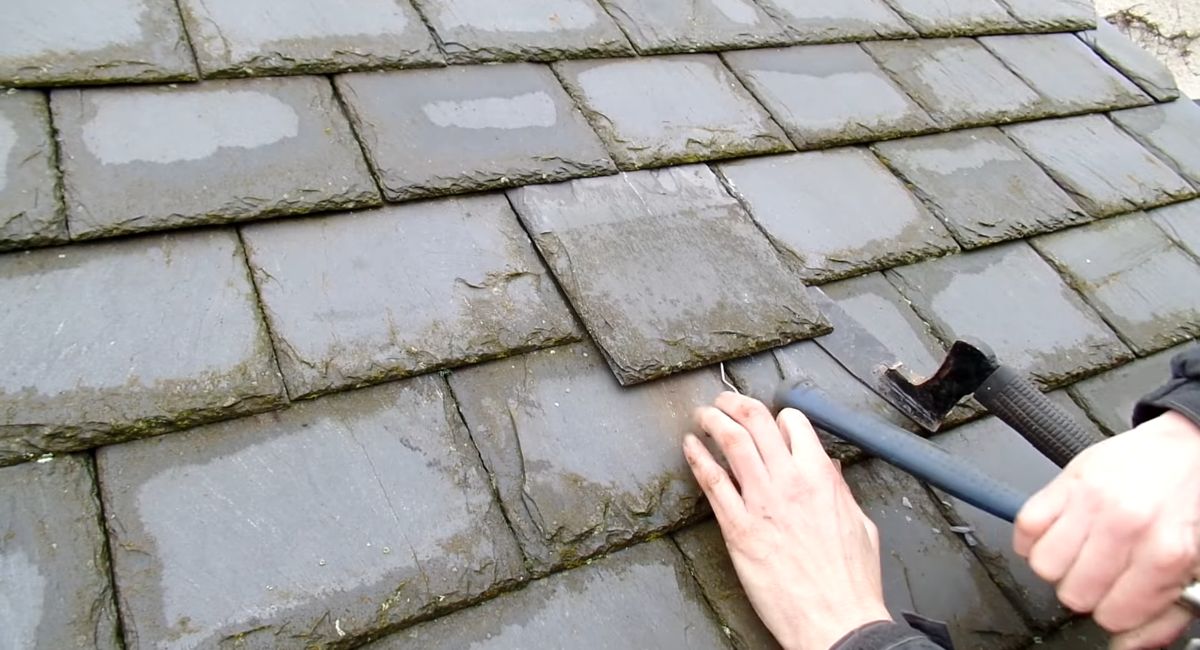
- Slide the ripper under the broken slate, hook a nail and strike the handle downward to cut it. Repeat for the second nail.
- Ease out the broken pieces and any fragments.
- Push the new slate up until its bottom edge lines up with its neighbors.
- Drive one copper nail through the vertical joint in the course above, just below the bottom edge of the slate two rows up. Stop before the head pinches the stone.
- Slide a copper bib, about 3 by 8 inches, under that joint so it covers the nail head.
Nothing above the broken slate comes off.
Why the Old Nails Are Out of Reach
Each slate gets nailed near its top edge. Slating starts at the eaves and works up the roof, and every new row laps over the nails of the row below. Roofers call that overlap headlap, and it keeps water away from the nail holes.
Headlap is also why prying the upper slates loose is a bad plan. Old slate snaps when you bend it, and one broken piece can turn into three while you chase a single nail.
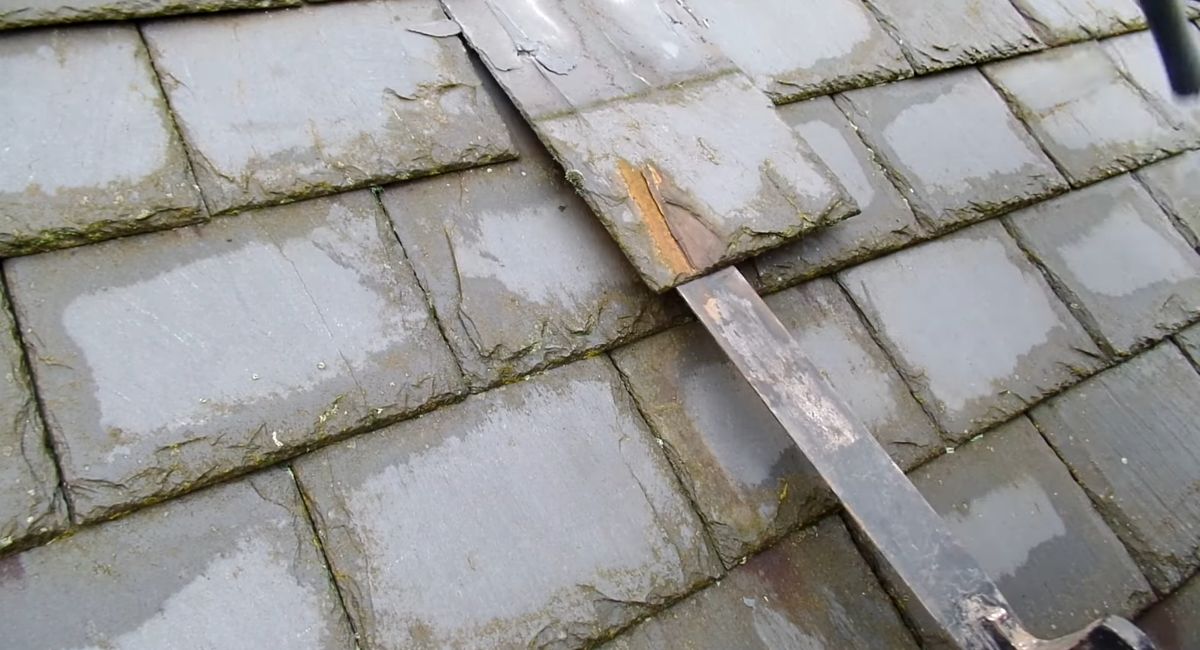
Slate ripper. A long, flat steel blade with a hooked, barbed tip. It slides under a slate, catches the shank of a hidden nail, and cuts or pulls that nail when the handle is struck downward with a hammer.
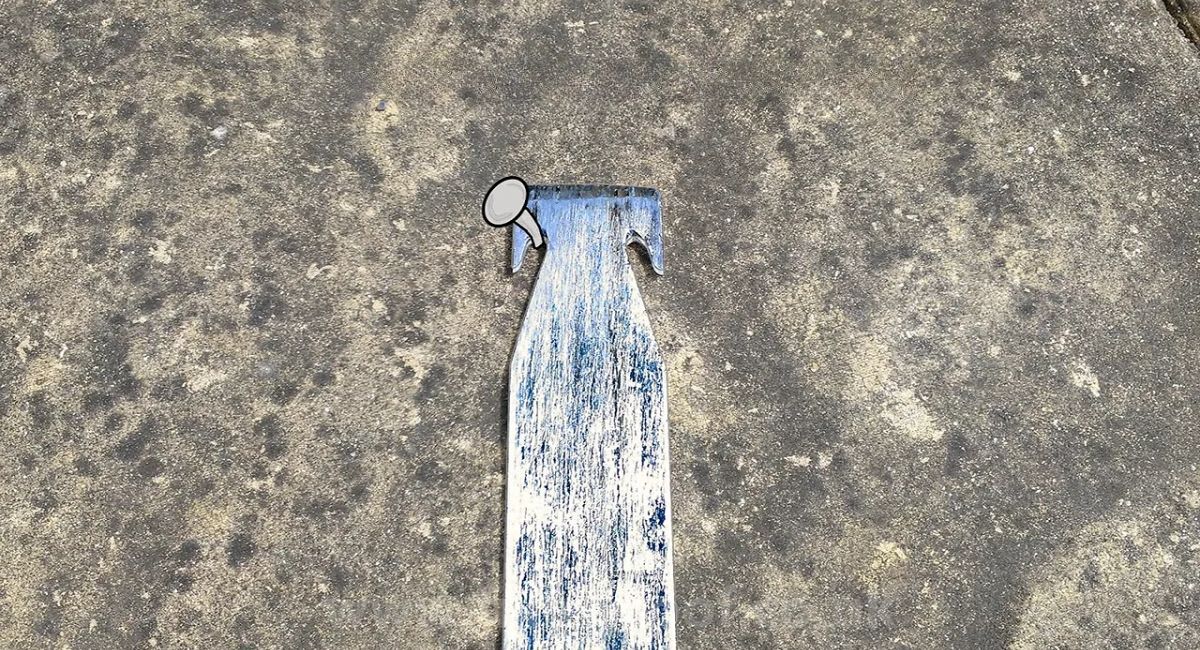
The ripper reaches the nail without disturbing anything above it.
Copper Bib, Copper Tab or Slate Hook
There are three common ways to hold the new slate.
| Method | How It Holds | What Shows | Watch For |
|---|---|---|---|
| Copper nail and bib | Nail through the joint above, bib over it | Almost nothing | The nail must miss any flashing underneath |
| Copper tab, called a tingle in British guides | Strip nailed to the deck, bent around the bottom edge | About 1 inch of copper | Snow and ice can pry the bend open |
| Slate hook | Hook catches the bottom edge | A small metal hook | Copper or stainless only |
The federal GSA procedure for minor slate repairs covers the bib and tab methods and says the tab should not be used in northern climates.
On a roof that holds snow, I lean toward the nail and bib because nothing hangs at the bottom edge for ice to grab.
Watch how a broken roof slate is replaced using the Hall hook method, which secures the new slate without removing the surrounding slates.
Shortcuts That Turn One Slate Into a Bigger Repair
A one-slate repair rarely fails because the job was hard. It fails because somebody grabbed the wrong material. The National Park Service guide to repairing and maintaining historic slate roofs warns against several of these directly.
- Roofing cement smeared over the crack. The Park Service says mastic is not a real repair, because it hardens, cracks and lets water back in.
- Steel or galvanized nails. They usually rust out long before the slate wears out. I keep more hardware than any sensible person needs, but galvanized nails are the last thing I would reach for on slate.
- A nail driven tight. Slate should hang on the nail. A head driven hard against the stone cracks it.
- Walking across the slope. Footsteps break the slates you were not trying to fix.
Finding a Slate That Actually Matches
The replacement has to match more than color. Length and width decide whether the bottom edge lines up with its neighbors, and thickness decides whether the new piece sits flat or rocks under the slates above.
Match the weathered color you see today, not the color the stone had when it was new. Salvaged slate is often the closest match, and the Park Service accepts it for repairs. Bring a broken piece when you look for one, because a phone photo lies about color.
Did You Know?
Pennsylvania ribbon slate, the gray stone with darker bands across it, is no longer quarried. Mottled gray Vermont slate is the closest match available today, so owners of ribbon slate roofs should keep every sound piece that comes off.
When the Broken Slate Is a Warning Sign
One slate broken by a storm or a falling branch is a repair. A slate that slipped with no visible damage tells a different story, and so does a ceiling stain that keeps coming back after the slate is replaced. Water has a habit of showing up a long way from where it got in.
Important: Signs of a Larger Roof Problem
- The Park Service says that when 20 percent or more of the slates on a roof or slope are broken, missing or sliding, replacement is usually cheaper than repair.
- Sound slates sliding out of place usually mean the old nails are rusting through across the whole slope.
- Repeated repairs in the same small area point to rotting decking or failing flashing.
Knowing how old your roof actually is helps you read that pattern.
What You Can Check Yourself and Where to Stop
Your part of the job happens on the ground and in the attic. A pair of binoculars will show a slate sitting lower than its neighbors, a clean break line or an empty gap. Spotting that from the passenger seat is a habit of mine, and my wife likes to remind me that nobody asked.
After a hard rain, take a flashlight into the attic and look for damp sheathing near the failed slate.
The roof itself is where I draw the line. Slate breaks under a boot, so professionals work from a roof ladder hooked over the ridge. Getting up there is risky on its own, and most gutter cleaning injuries start with the ladder.
What Homeowners Ask About Slate Repairs
1. How long should the copper nail be?
The GSA procedure calls for large-head hard copper nails roughly twice the slate thickness plus 1 inch. Standard slates up to 18 inches long take a 3d nail, longer slates a 4d, and hip and ridge slates a 6d.
2. Can I fill the gap with a synthetic slate or an asphalt shingle?
You can, but it will look like a patch and age differently from the stone around it. The Park Service favors natural stone when deciding between natural and synthetic slate.
3. How long does a slate roof normally last?
The Park Service puts most slate roofs at 60 to 125 years or longer. Its rough guide gives about 125 years for Vermont and New York slate and 175 years or more for Buckingham, Virginia slate.
4. Should I keep the old slates that come off?
Yes, if they are whole and sound. Both federal guides treat full salvaged slates as stock for future repairs.
5. Will homeowners insurance pay to replace one broken slate?
Sudden damage such as a falling limb is often covered, while slow wear usually is not. Get the repair quote first, since one slate may cost less than your deductible. Read your policy and learn how insurers value an older roof before filing.
Before Anyone Climbs Up
If you spot one broken or slipped slate, photograph it from the ground, check the attic after the next rain and call a roofer who works on slate regularly.
Ask three questions before the work starts. Which method will hold the new slate, a bib, a tab or a hook? Are the nails copper or stainless? Where will the crew stand so nobody walks on the stone?
A roofer who answers all three without hesitating understands that one cracked slate is a small job. A roofer who reaches first for a caulk gun or a full replacement quote deserves a second opinion.

I’m Mike Carter, a roofing and gutter contractor who has spent most of my working life on roofs, up ladders and around job sites. I’ve worked with everything from asphalt shingles and metal roofing to flat roofs, flashing, fascia, gutters and drainage systems.
On Gutter N Roof, I share what I’ve learned from the years of experience, so homeowners can understand what’s happening above their heads and know when something needs attention.