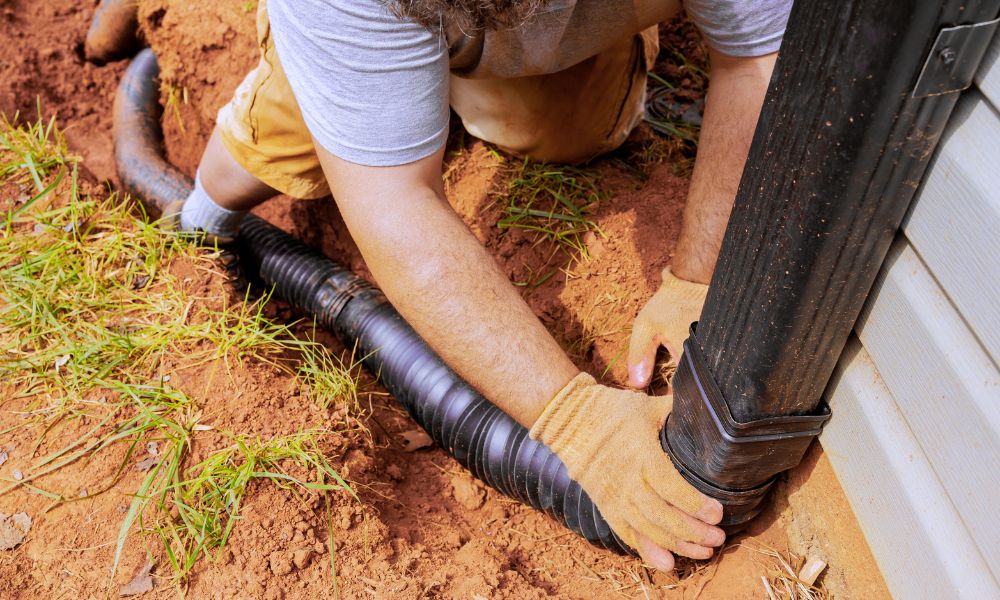
Gutter quotes often carry three words near the bottom, 5-inch K-style seamless, with no explanation attached.
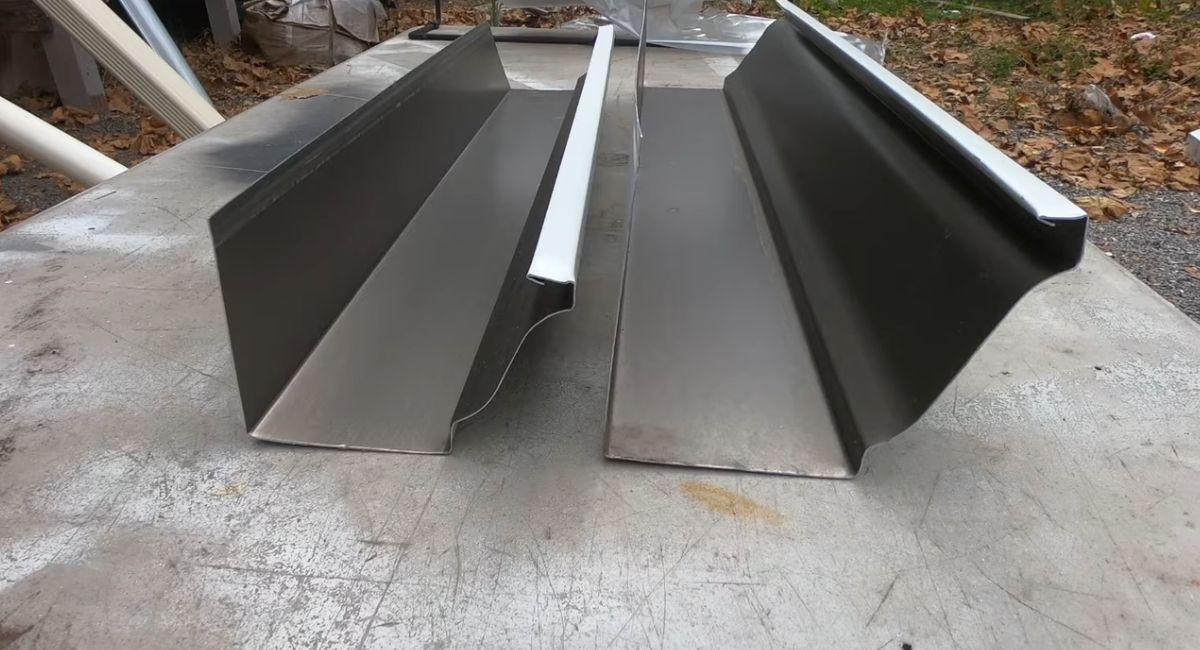
K-style gutters are the flat-backed gutters with a front shaped like crown molding, and they are the gutter you see on most suburban houses.
For most homes they are a sensible choice, but the shape matters less than the width, the downspouts and the way water leaves your roof.
My wife will tell you I cannot drive past a house without checking where its downspouts end. She usually adds that nobody asked.
Below is what I actually look at before I put K-style on a house.
What Makes a Gutter K-Style
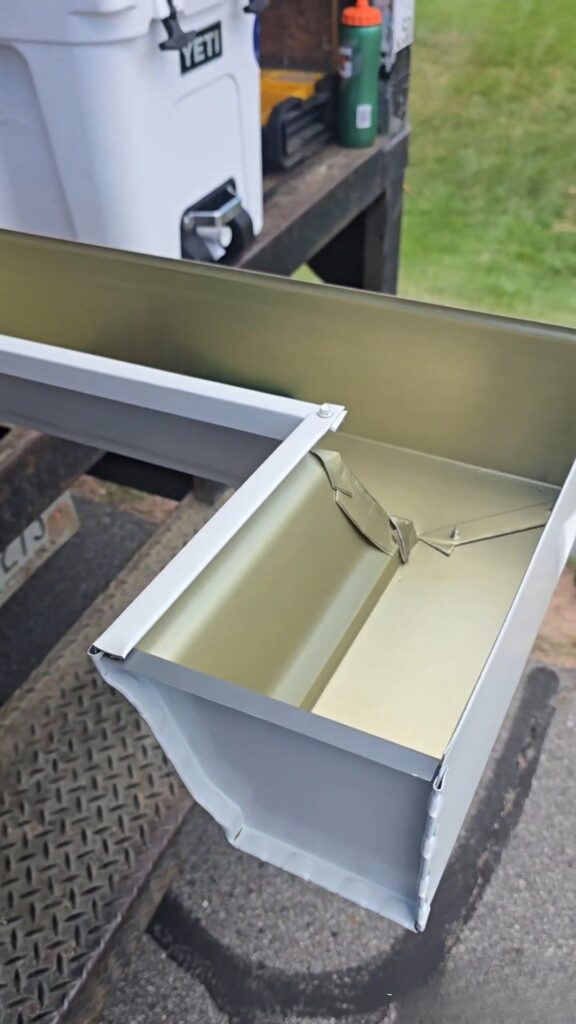
Look at the end cap of a K-style gutter and you see the whole design. The back is flat, so it sits tight against the fascia board, the trim board along the roof edge.
Its bottom is flat too, and the front curves like living room crown molding.
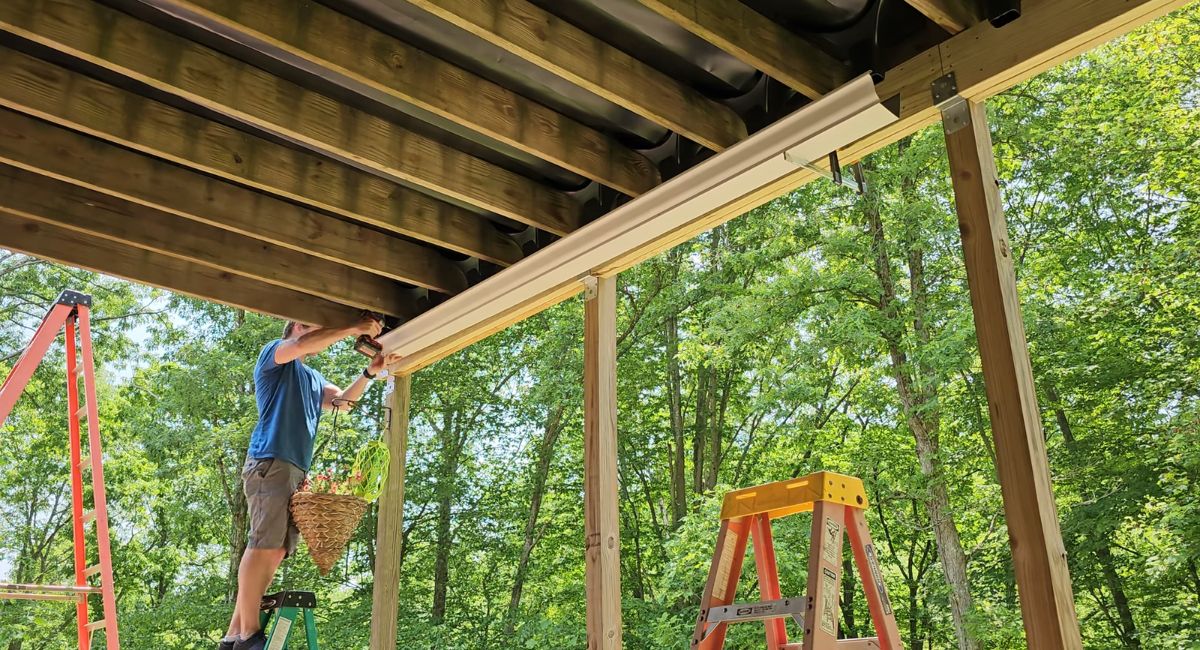
Most K-style systems hang on hidden hangers, brackets that sit inside the trough and screw through the gutter back into the fascia. Everything depends on that board being solid, so I check the fascia first.
Where does the K come from?
The K is a catalog letter, not a picture. New York State’s master construction specification for gutters lists formed rectangular gutter profiles as Style A through Style L, using designations from SMACNA and NRCA, two sheet metal and roofing trade groups. K is the eleventh shape on that list. The same profile is also called an ogee gutter.
Why K-Style Became the Standard on American Homes
K-style did not take over because of one clever feature. It took over because it is easy to make, easy to hang and easy to match.
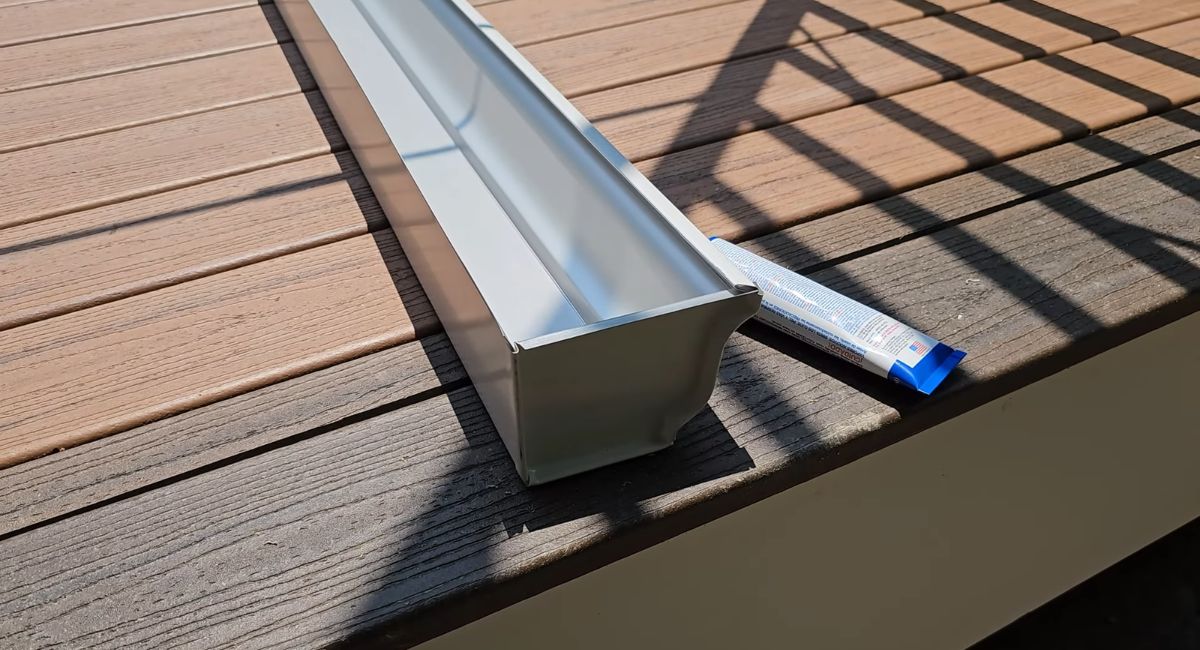
A seamless run is formed on site from a coil of metal, so a crew can make one continuous piece the length of a wall, with joints only at the corners.
- The flat back fastens straight to the fascia, so no brackets hang below the gutter.
- End caps, outlets, corner miters and hangers are stocked almost everywhere in 5-inch and 6-inch sizes.
- Aluminum versions come in a wide range of factory colors, so matching trim is rarely a special order.
- Installed cost usually runs below half-round, which is often copper and needs round brackets.
Availability matters more than people expect. When a storm pulls a section loose, a stocked part means the repair happens this week.
See how K-style and half-round gutters differ in design, installation, and suitability for different homes.
The Capacity Claims You Will Read Do Not Agree
Read five gutter company pages and you will find five answers. One says K-style holds 40 percent more than half-round. Another uses the same 40 percent figure to compare a 6-inch gutter with a 5-inch one. None of them show their math.
The Department of Energy takes a calmer view. Its Building America guide to gutters and downspouts treats the choice between K-style and half-round as mostly about appearance, with no substantial difference in performance. It adds that a bigger channel only helps when enough downspouts drain it.
Both can be true. Draw the two shapes at the same width and the flat-bottomed K holds more water in cross-section. But a gutter is a channel, not a bucket. It only clears water as fast as its outlets let it leave, so I trust downspout math over any percentage on a sales page.
When K-Style Gutters Are the Right Call
On most houses I look at, K-style is my starting point unless something specific pushes me elsewhere. It fits well in the following situations.
- The fascia is straight and sound, so hidden hangers have solid wood to grab.
- You want seamless runs with joints only at the corners.
- Steep or long roof planes send water off fast, and you want the option of a 6-inch trough without custom parts.
- Heavy downpours are normal where you live.
- The trim and siding are plain or modern, so a crown-molding front blends in.
- Budget matters and aluminum is the material your installer stocks in the most colors and sizes.
If two or three of those describe your house, K-style is usually the practical answer. The bigger decisions are the width and where the downspouts go.
Picking 5-Inch or 6-Inch and Matching the Downspouts
Gutter width gets the attention, but downspouts do most of the work. Texas A&M rainwater harvesting guidance calls for 1 square inch of downspout opening for every 100 square feet of roof, with gutters at least 5 inches wide.
Quick sizing rule: Plan for roughly 1 square inch of downspout opening per 100 square feet of roof area, according to Texas A&M guidance. This is a useful starting point, but local rainfall intensity and the roof layout still matter.
See how 5-inch and 6-inch K-style gutters compare before choosing the right size for your roof.
| Downspout size | Opening | Roof area served (Texas A&M rule) | Common pairing |
|---|---|---|---|
| 2 x 3 inches | 6 sq in | About 600 sq ft | 5-inch K-style |
| 3 x 4 inches | 12 sq in | About 1,200 sq ft | 6-inch K-style, or 5-inch on long runs |
As an example, a roof plane 50 feet long and 20 feet from eave to ridge puts 1,000 square feet of roof into one gutter. A single 2 x 3 downspout covers about 600 of that, so the run needs two of them or one 3 x 4.
When I Would Choose Something Else
Sometimes K-style is the wrong answer, and sometimes the gutter is not the problem at all. Half-round still makes sense on older homes where it was the original look.
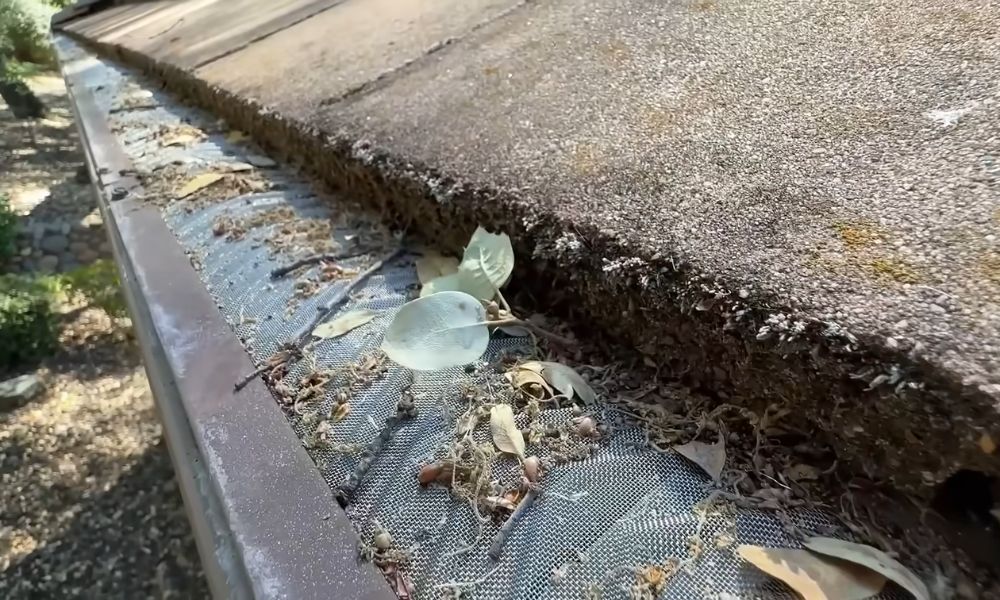
Under heavy leaf or pine needle drop, the rounded bottom sheds debris better than the inside corner of a K, where wet leaves pack solid.
Picture a valley, the inside corner where two roof slopes meet, emptying into the last few feet of gutter beside a garage.
Upsizing the whole house to 6-inch does little there. A downspout near that corner often fixes the spill for far less money.
Overflow doesn’t automatically mean your gutters need replacing. Even clean gutters can still overflow when the slope is incorrect or downspouts can’t handle heavy rainfall.
If large trees overhang your roof, whether gutter guards are worth it depends more on the amount and type of debris you’re dealing with than the gutter profile itself.
What You Can Check From the Driveway
You can learn a lot without leaving the ground. Start with three checks.
- Watch during a hard rain. Water sheeting over the front at one spot points to a valley, a clog or a low spot, not necessarily an undersized gutter.
- Sight down the run from one end. The gutter should fall gently toward each outlet, and the Building America guide calls for at least 1/16 inch of slope per foot of run.
- Look at the fascia and siding under the gutter. Dark streaks, peeling paint or soft wood usually mean water is getting behind the gutter.
Anything above the second rung belongs to someone with the right ladder setup. I do not like seeing a homeowner twenty feet up a ladder with a leaf blower in one hand, and emergency room visits during gutter season show why.
Questions Homeowners Ask
What you should do?
Before you sign a gutter quote, ask for four details in writing, namely the gutter width, the downspout size and count, the aluminum thickness and the hanger spacing.
Before you approve a gutter quote, check these four details:
- Gutter width: 5-inch or 6-inch
- Downspout size and total count
- Aluminum thickness
- Hanger spacing
A quote listing only 5-inch K-style seamless and a price leaves out what decides whether water stays away from your foundation.
If a valley empties near one corner, ask where that water goes and whether an extra downspout belongs there.
My wife is right that nobody asks me about downspouts on the drive home. When the house and the bill are yours, you should ask.

I’m Mike Carter, a roofing and gutter contractor who has spent most of my working life on roofs, up ladders and around job sites. I’ve worked with everything from asphalt shingles and metal roofing to flat roofs, flashing, fascia, gutters and drainage systems.
On Gutter N Roof, I share what I’ve learned from the years of experience, so homeowners can understand what’s happening above their heads and know when something needs attention.