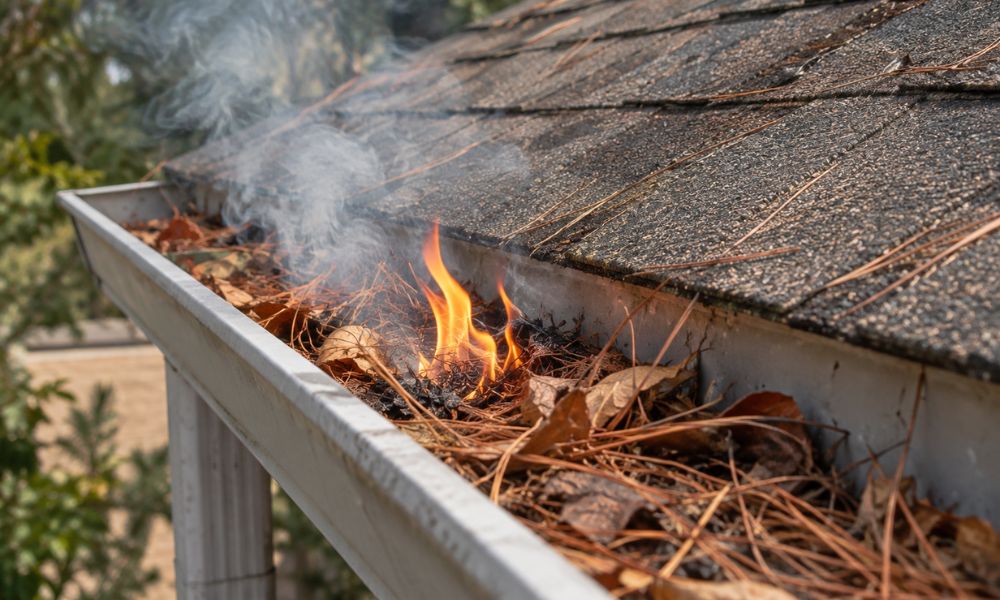

A few years back, my wife and I spent a long weekend in Washington, D.C. Outside the National Cathedral, she was admiring the carved stone while I was staring at a creature hanging off the wall with its mouth wide open.
I told her it was a downspout. She gets slightly annoyed when I’m being a smartypants, but I was right, though.
A gargoyle is a carved drain that throws roof water away from the wall, and once you look at it that way, the history makes a lot more sense. So does the gutter system on your own house.
The Name Gargoyle Comes From a Throat That Spits Water
The word gives the game away. According to the history of the word gargoyle, English speakers were using it by the late 1200s, and the Old French gargoule meant both a throat and a carved downspout. The same root gave us the verb gargle.
Anyone who has stood under a stone spout in a hard rain knows the name fits. I like that builders named the thing for what it did, not for how it looked. Medieval masons were not dreaming up monsters first.
Their real worry was where hundreds of gallons of water would go once they left the roof.
Stone Buildings Hate Standing Water More Than Anything
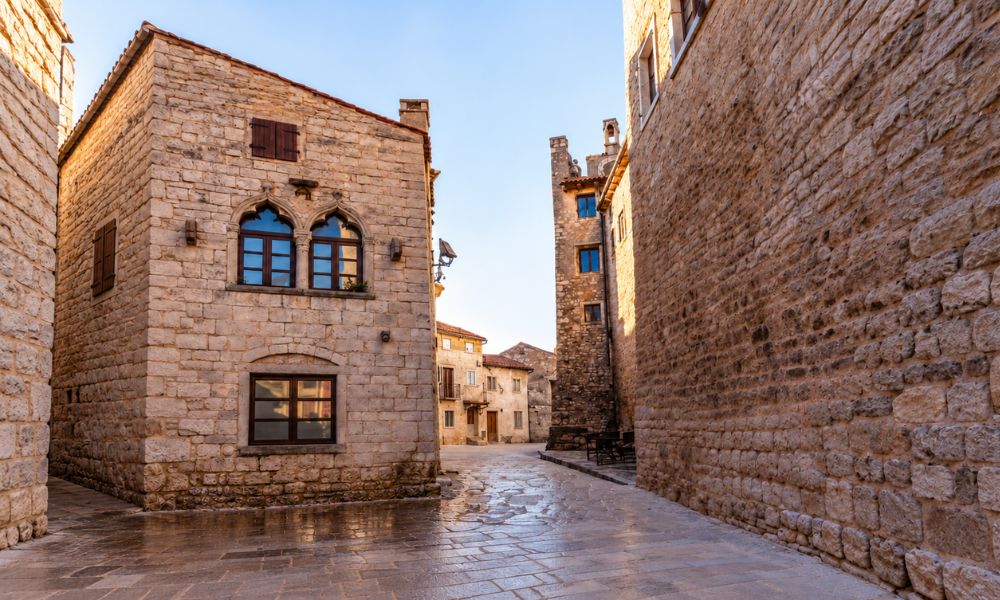
Water is the slow enemy of masonry. It soaks into mortar joints, freezes, expands and pushes stone apart.
Medieval builders ran roof water into a channel behind the parapet wall, and the gargoyle carried it out.
As the Britannica entry for students describes, Gothic examples often sat on a cornice and projected several feet so the stream landed well away from the wall and foundation.
To give you a sense of the volume, here is roughly what one inch of rain puts on an ordinary house roof.
| Roof area (square feet) |
Water from 1 inch of rain (gallons, approximate) |
|---|---|
| 1,000 | 600 |
| 1,500 | 900 |
| 2,000 | 1,200 |
| 2,500 | 1,500 |
A cathedral roof is many times larger than any house I have worked on, so its builders needed a serious answer.
Gargoyles Were Around Long Before the Cathedrals
People tend to picture gargoyles as a medieval invention. The idea is older.
Builders had been carving spouts for a long time before anyone in France put a scowling beast on a cathedral.
A few points stand out when you trace the line back.
- Classical Greek and Roman buildings used carved lion heads along the cornice as waterspouts.
- Roman structures at Pompeii had spouts made of terra-cotta, the same fired clay used for roof tiles.
- By the 13th century, French masons were trading the lion for birds, beasts and strange half-human figures.
- A legend from Rouen ties the name to a dragon called Gargouille, said to have been defeated by Saint Romanus. It is a story, not a building record.
What I notice is that the job never changed. The face was the part each era got to play with, while the spout underneath kept doing the same plain work.
Not Every Stone Monster Is a Gargoyle

On that trip, I learned how many of the creatures I had been pointing at were not drains at all.
A report on the National Cathedral carvings from NBC4 Washington counts about 112 gargoyles and roughly 1,130 grotesques.
Only the gargoyles carry water, and they work in a cascade, passing the flow down level by level until it reaches the ground.
The most famous carving there is a grotesque. Darth Vader sits on the north side of the building, the result of a 1985 design contest run by National Geographic World magazine, and it went up in 1986.
Did You Know?
The famous creatures leaning over the railings of Notre-Dame in Paris are not gargoyles either. Those ornamental chimeras drain no water, even though postcards call them gargoyles.
My wife now enjoys correcting other people on this, which I count as a win.
How Gutters and Downpipes Took Over the Job
Gargoyles have a weakness any roofer can spot. They throw water in a big, uncontrolled arc, and on a windy day it lands on whoever walks underneath. Cities eventually wanted that water brought down the wall in a pipe.
The London Building Act of 1724 required downpipes on the front elevations of houses, according to a heritage guide on Georgian rainwater goods. Until the late 1700s, those gutters and pipes were made of lead.
Cast iron replaced lead from the end of the 18th century, as the Welsh heritage service Cadw explains in its guidance on historic rainwater disposal. Builders still could not resist decorating. Lead hopper heads at the top of downpipes often carried the initials of the owner and a date.
I count those hopper heads as the gargoyle surviving in a smaller form. Somebody still wanted the drainage to look like it belonged to them.
To see how those carved creatures fit into a working drainage system, take a look at the video below. It brings us back to the job behind the face: getting rainwater off the roof and away from the walls
What Your Downspout Should Learn From a Gargoyle
Last spring I looked at a ranch house with a damp corner in the basement and a bag of patching cement waiting by the stairs.
Nothing was wrong with the gutter above that corner. The downspout, though, ended about 12 inches from the foundation and dumped the back half of the roof against the wall.
A gargoyle would have done better. The Building America guide on gutters and downspouts from the Department of Energy sets three useful targets.
- Carry downspout water at least 5 feet from the building, or to an underground catchment at least 10 feet away.
- Allow 1 square inch of downspout opening for every 100 square feet of roof.
- Space downspouts 20 to 50 feet apart, with a splash block where the water lands.
If you plan to check yours from a ladder, read my notes on why fall gutter cleaning sends homeowners to the ER first.
Frequently Asked Questions
Check Where Your Water Lands Next Time It Rains
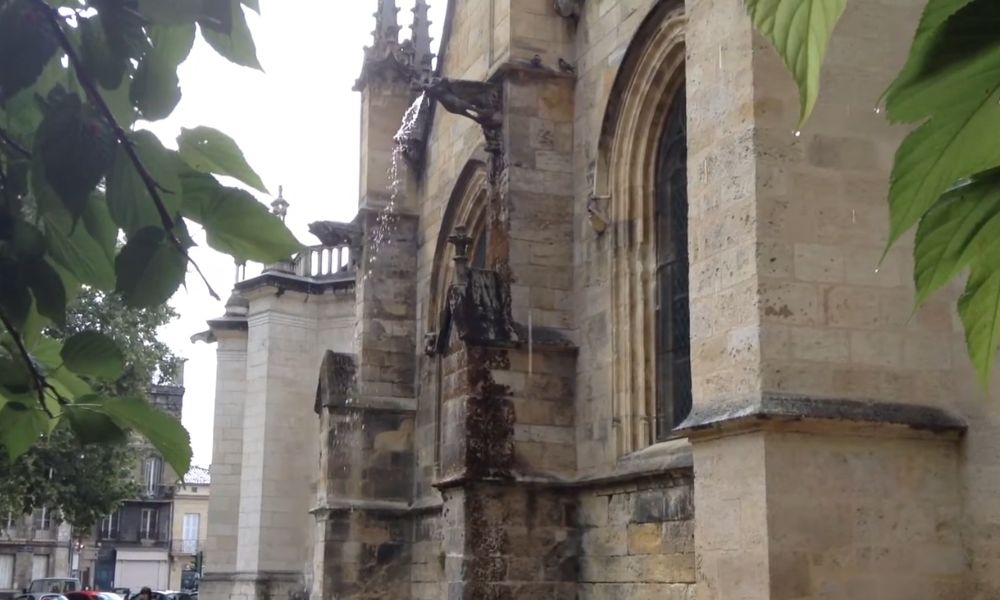
Next time it rains hard, put on a jacket and walk around the house while the water is moving. Look at where each downspout lets go.
A Gothic gargoyle pushed its stream several feet out from a stone wall, and nobody had to remind it to do that.
Your downspout has no face and no reputation, so the checking falls to you.
If water lands within a foot or two of the foundation, a simple extension or a splash block may be all it takes.
When the gutter is overflowing at the top instead, the trouble starts higher up, at the roof edge, and that calls for a closer look.

I’m Mike Carter, a roofing and gutter contractor who has spent most of my working life on roofs, up ladders and around job sites. I’ve worked with everything from asphalt shingles and metal roofing to flat roofs, flashing, fascia, gutters and drainage systems.
On Gutter N Roof, I share what I’ve learned from the years of experience, so homeowners can understand what’s happening above their heads and know when something needs attention.